Why pilings fail here, and what kind of water you're on
Pilings do the entire job of holding a dock up, and in Northeast Florida they fail for three reasons — but which one is coming for yours depends heavily on where you keep your boat.
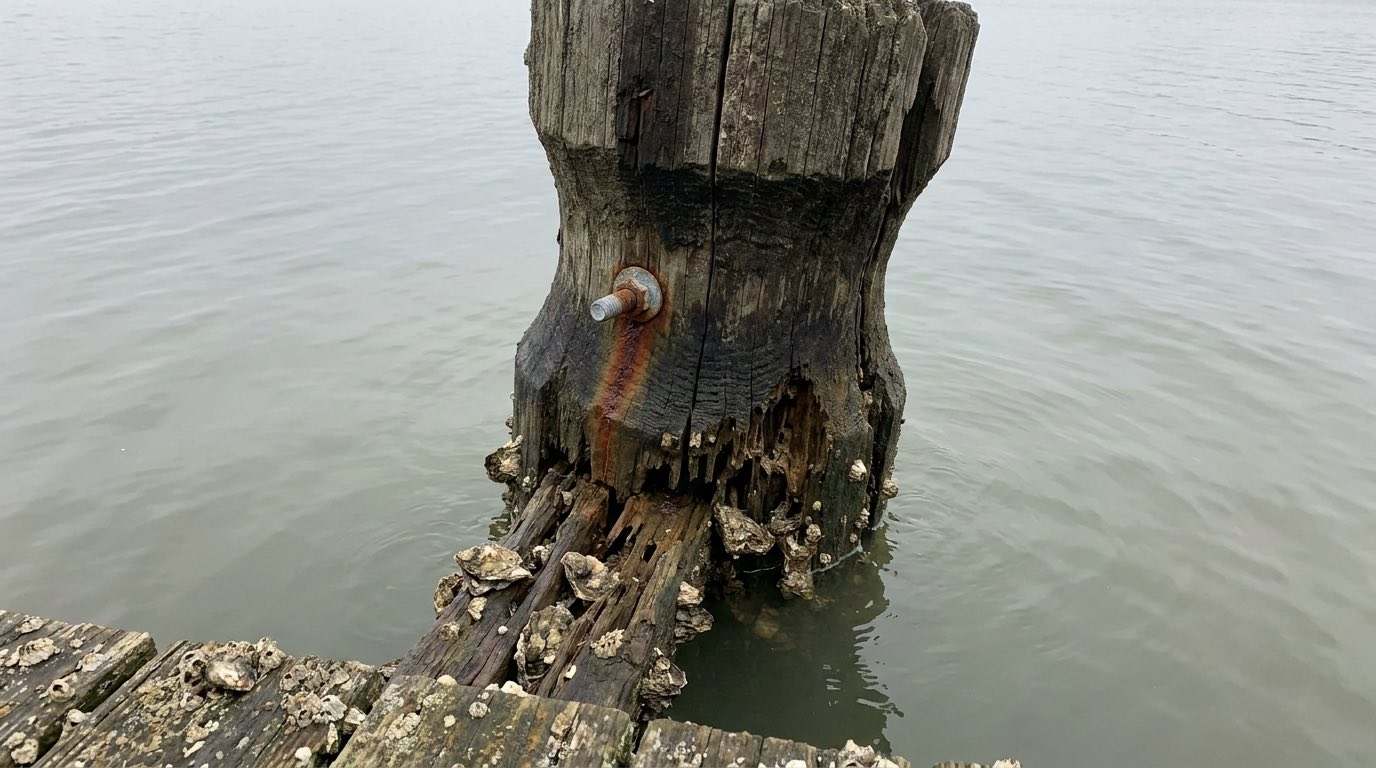
Marine borers are the salt-water problem. Shipworms and gribbles attack untreated or compromised timber below the waterline and hollow it from the inside out. The signature is hourglassing: a piling that has visibly narrowed at and just under the waterline while the section above still looks perfectly sound. Docks around Mayport, the Intracoastal, and the salt marsh on Amelia Island live with this.
Fungal rot is the near-fresh-water problem. On Doctors Lake, Black Creek, and the upper St. Johns at Green Cove Springs, there are no borers to speak of — but constant moisture, no salinity to inhibit growth, and tannic water produce slow decay concentrated right at the waterline and around every through-bolt hole where water sits.
Loading and impact finish the job everywhere. Storm surge, sustained high water, wave action against a dock built for calmer conditions, and the occasional hard landing by a boat all accelerate whatever decay is already underway. A piling that was quietly weakening for years is often the one that visibly moves after a named storm.
The warning signs, in the order they show up
Piling problems announce themselves gradually, and most owners notice them in roughly this sequence. First, flex — the dock feels springier or sways more than it used to when you walk out on it. Second, visible profile change at the waterline: narrowing, deep checking and splitting, soft punky wood that takes a screwdriver tip with no resistance, or rust streaking bleeding down from through-bolts.
Third, and the one people usually call about, the dock goes out of level. A dip develops in one run, a section crowns, or the whole platform takes on a slope that wasn't there. This is the stage at which people start searching for "dock leveling" — and it's worth being clear about what that phrase actually means.
"Dock leveling" isn't a surface job. A dock that's out of level is reporting that a piling has settled, shifted, or lost capacity, or that framing has sagged between supports. Re-laying decking over it changes nothing — the new boards simply follow the structure back down. The fix is underneath.
Repair options, from cheapest to most involved
A marine contractor inspecting the piling in person will generally be choosing between three approaches, and the deciding factor is how much sound structural wood is left.
Wrapping or jacketing. Where the damage is localized at the waterline and the piling still has genuine capacity, the compromised zone can be encased — typically with a fiberglass or PVC jacket and a grout or epoxy fill — to restore section and block further borer access. This is the least disruptive option and preserves the existing piling. It only works if the core is still sound.
Sistering. A new piling is driven immediately alongside the failing one and the framing is re-tied to it, transferring the load. This is common where a piling is too far gone to jacket but the surrounding structure is fine and full removal would be disproportionately disruptive.
Replacement. Where the piling is hollowed through, badly hourglassed, or has actually moved, it gets pulled or cut and a new one driven. This is the most involved option, requires the right equipment on the water, and is what an out-of-level dock most often ends up needing.
We're deliberately not quoting dollar figures here, because honest ones don't exist in the abstract — cost swings enormously on access, water depth, piling length, how many are involved, whether a barge is needed, and what the permitting turns out to require. Anyone giving you a firm per-piling price before seeing the dock is guessing.
Permitting: not optional, and not a formality
Marine construction in Florida is regulated work. Piling repair and replacement generally requires permitting through your county building department, frequently with the water management district involved, and in some situations the Army Corps of Engineers as well. Requirements vary between Duval, St. Johns, Clay, and Nassau counties, and they vary again depending on whether you're on a navigable waterway, in a marsh, or in a conservation-designated area.
A reputable licensed marine contractor treats permitting as part of the job and will tell you upfront what your dock needs. Treat it as a screening question: if someone offers to replace pilings with no license, no permit, and cash pricing, that is the single clearest warning sign in this entire category of work. Unpermitted marine construction creates real problems at sale, at insurance claim time, and with code enforcement.
What we do, and what we don't
We want to be straightforward about this, because the search that brought you here may have been looking for a contractor. 904 Boat Detailing does not do structural dock work. We don't repair, wrap, sister, or replace pilings, we don't level docks, and we don't touch framing or bulkheads. That's licensed marine contracting, and it should be done by someone who holds the license and pulls the permit.
What we do is the surface: dock cleaning and sealing across Jacksonville and the 904 — soft washing algae, mildew, and tannin staining off the boards, and sealing the wood so it stops absorbing the water that drives rot in the first place. That's genuinely relevant to the topic of this page in one specific way: sealed wood decays more slowly than bare wood, and a clean dock is one where you can actually see the early warning signs described above instead of having them hidden under a layer of green.
If you'd like a starting point for assessing your own dock, our dock inspection checklist walks through what to look at and what each finding means.