
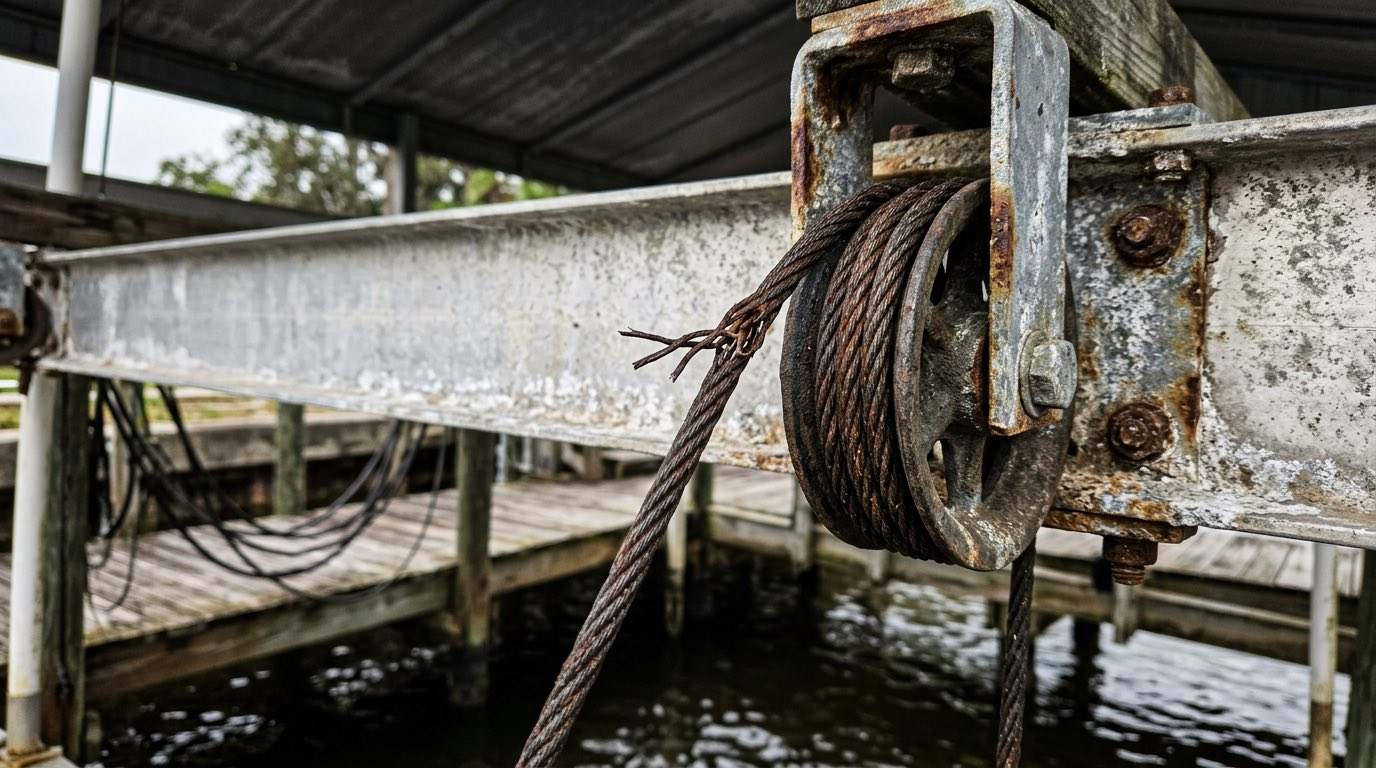
Cables fail from the inside out
If a lift fails, it is most often the cables — and the reason they catch people out is that they corrode from the inside. Galvanized or stainless lift cable is a bundle of wound strands, and salt water wicks into the core where you can't see it. By the time you notice rust bleeding through the outer wrap or a broken strand poking out, the interior may have been losing capacity for a long time.
On salt and brackish water — Mayport, the Intracoastal, the Amelia River marsh — three to five years is a common working life. On the near-fresh water up at Doctors Lake and the upper St. Johns, cables often last longer, but they still age. This is why lift technicians generally recommend replacing on a schedule rather than waiting for a visible fault, and why cables are always replaced as a matched set — a fresh cable paired with a three-year-old one just concentrates the load on the weak side.
The reason this matters more than a normal maintenance item: a cable failure happens under full load, with a boat in the cradle, usually with someone standing nearby. It is the one dock failure mode with a genuine injury risk attached.
Pulleys, sheaves, and the sounds they make
Pulleys are the second thing to go, and they take cables with them. A sheave that has seized, developed flat spots, or worn a groove into its face will chew through cable far faster than normal service. The diagnostic is mostly acoustic: run the lift empty and listen. Squealing, groaning, clicking, or a rhythmic noise that tracks with cable travel all point at the pulleys. So does a lift that has started to hesitate at a particular point in its travel.
Visually, check that each pulley spins freely, that nothing is visibly grooved or chipped, and that the cable is tracking in the sheave rather than riding up the edge. Cable that has jumped a sheave will damage itself quickly.
Cradle beams, bunks, and level travel
The cradle is what actually holds your boat, and its wear is slower but just as consequential. Look for corrosion on the beams, particularly where they sit in or near the water on a lift that stays low, and for bunk carpet that has worn through to the timber underneath — worn bunks mark hulls and let a boat sit unevenly.
The most useful single check is whether the cradle rises level. Run the lift up and watch both ends. If one side leads the other, or the beams are no longer parallel, something is out — cable stretch on one side, a drum winding unevenly, or a mount that has shifted. A boat lifted on an out-of-level cradle is being supported wrong, which is hard on the hull and hard on the lift.
Rinse it, and clean around it. The cheapest life extension available on a lift is fresh water. Salt left to dry on cables, hardware, and the motor housing corrodes continuously, and marine growth on submerged beams holds moisture against metal. Rinsing after salt exposure and keeping the structure clean costs almost nothing against what a cable-and-pulley job costs.
Motor, gearbox, and electrical
The drive unit is where the money is. Give the motor housing a visual check for corrosion, cracked or missing covers, and any sign of water intrusion, and check that the mounting is solid. A motor that has begun labouring, tripping its breaker, or running hot is telling you something — and the correct response is a technician, not persistence.
Dock electrical deserves a specific warning. Corroded or cracked outlet covers, non-GFCI receptacles, damaged conduit, and any exposed wiring near water are all findings to report to a licensed electrician, not to investigate yourself. Electricity around docks is a category where amateur diagnosis is genuinely unsafe.
What's owner maintenance, and what isn't
Reasonable owner maintenance: rinsing the lift with fresh water after salt exposure, keeping the structure and surrounding dock clean, greasing fittings on the manufacturer's schedule, visually checking cables, pulleys, and bunks, running the lift empty periodically to listen for changes, and keeping the boat within the lift's rated capacity.
Licensed work: replacing cables, servicing or replacing the motor and gearbox, repairing or rewiring electrical, repairing or replacing cradle beams and structural members, and anything involving the pilings the lift is mounted to. In Florida, marine construction and boat lift work is licensed contractor territory and frequently requires permitting through your county. It is also, as noted above, the category with real injury risk — this is not the place to save money on a handyman.
Where we fit
To be direct about it: 904 Boat Detailing does not repair boat lifts. We don't replace cables, service motors, or touch cradle structure or electrical. That's licensed marine contractor work.
What we do is cleaning. Our dock cleaning and sealing covers the decking, walkways, and catwalks around the lift, along with rails, ladders, and dock boxes, and we clean the lift's visible structure and cradle beams as part of the job — which, on salt water especially, meaningfully slows the corrosion clock. And because we're out there with the structure clean and in front of us, we'll tell you if something looks wrong so you can get the right trade to look at it.
For the broader dock walk-through, see our dock inspection checklist; for what's happening under the dock, see piling repair and leveling.