
Where blackwater meets the lake
Doctors Inlet sits at a genuinely distinctive spot on the map: the point where Black Creek empties into the head of Doctors Lake in Clay County. Black Creek is a true blackwater system — it drains cypress swamp and hardwood bottomland, and everything it carries downstream ends up in the water your dock stands in. That's what gives the creek its dark, iced-tea color, and it's why docks here behave differently from docks anywhere else we work.
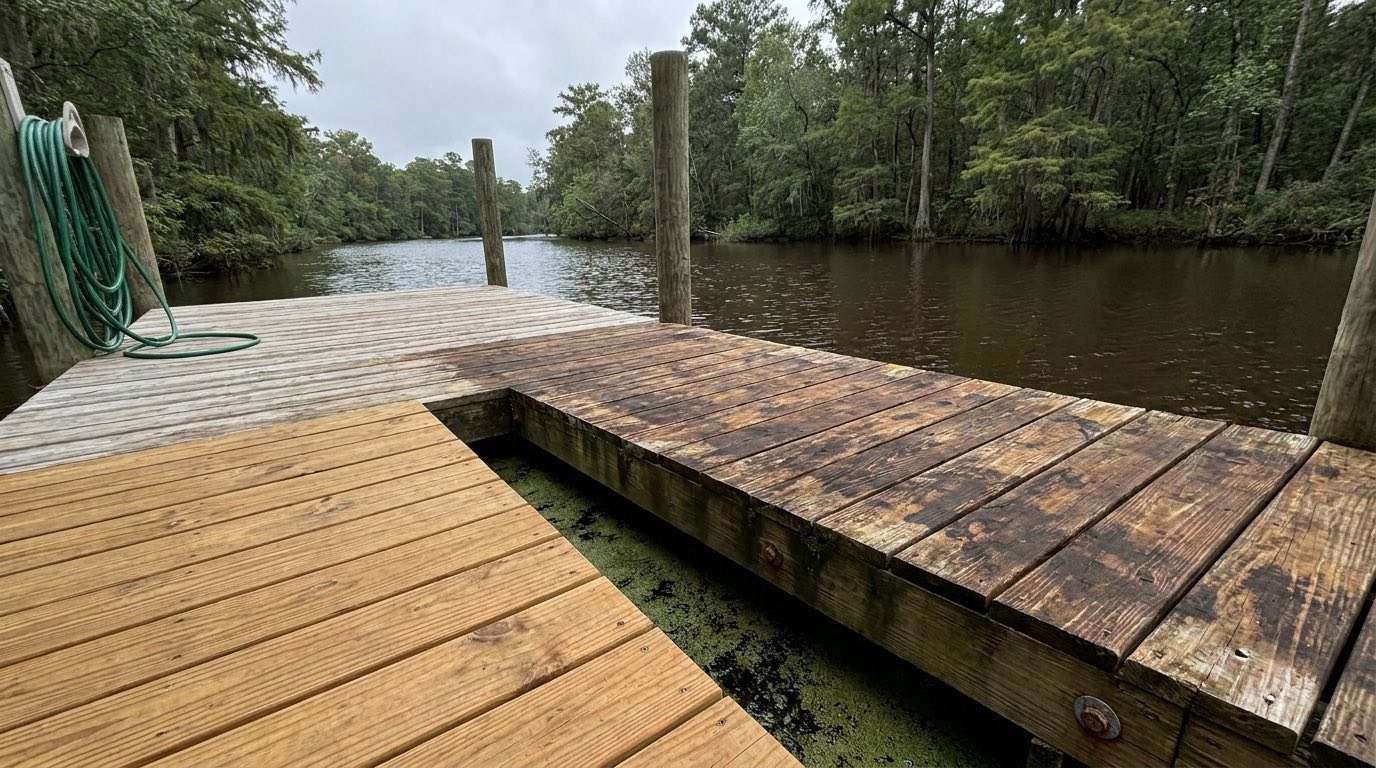
The practical consequence is simple: Doctors Inlet has the heaviest tannin load in the 904. Bare wood in this water browns faster and deeper than the same boards would on the brackish middle river down at Ortega, or even out on the main body of Doctors Lake. Add near-fresh water that never gets salty enough to slow biological growth, plenty of overhanging shade along the creek, and seasonal swings that put low decking underwater outright, and you have an environment that is extremely good at staining and growing things on wood.
What actually comes off, and what doesn't
Homeowners here often assume a dark, blotchy dock is permanently ruined and start pricing replacement boards. Usually it isn't. Most of what you're looking at is tannin that has soaked into the top layer of the wood plus algae and mildew rooted in the grain — both of which respond well to the right cleaner chemistry. What people try first, a high-pressure wand, is the one approach that reliably makes things worse: it strips the soft summerwood, raises the grain, leaves permanent wand tracks, and doesn't touch the staining that lives below the surface. The dock looks briefly striped and clean, then browns straight back.
Our default here is a low-pressure soft wash built around the staining. Cleaners selected for tannin and organic growth go on and do the work of lifting the brown and killing the algae down in the grain; a gentle rinse carries it away. Boards come back evenly toned rather than blotchy, and — critically — the surface is left intact enough to accept sealer. Concrete, composite decking, and aluminum get an approach matched to what they can safely take.
Cleaning is our lane; structure isn't. Rotted boards, loose fasteners, leaning pilings, and lift mechanicals are licensed marine contractor work in Florida. We clean and seal what's sound, and we'll tell you straight when something needs a contractor instead of a wash.
In Doctors Inlet, sealing is the whole point
On most of the water we work, sealing is a strong recommendation. Here it's close to the entire reason to do the job. Washing blackwater tannin out of bare wood and then leaving the wood bare means the creek starts putting it right back the next time the level comes up — you've bought yourself a season, maybe less.
Once the boards are clean and properly dry, we put down a penetrating marine-grade sealer that soaks into the grain instead of forming a film on top. It slows the moisture absorption that drives cupping, swelling, and rot around the fastener holes, and it substantially slows how fast the tannin staining comes back, because sealed wood simply doesn't drink the way bare wood does. Most Doctors Inlet docks land on a wash every year with sealer every two to three — and the low, shaded creek-side docks are the ones most likely to want the wash twice.
Where we clean docks in Doctors Inlet
Our work here is almost entirely private residential docks — the walkway-and-platform docks and covered lifts that line the creek banks and the upper lake shoreline. We cover the docks at the head of Doctors Lake, up into both forks of Black Creek, and along the waterfront properties off the Highway 17 corridor. Because we run Fleming Island and Orange Park on the same route, getting on the schedule in this corner of Clay County is usually easy.