Near-fresh water, and nothing to slow the growth down
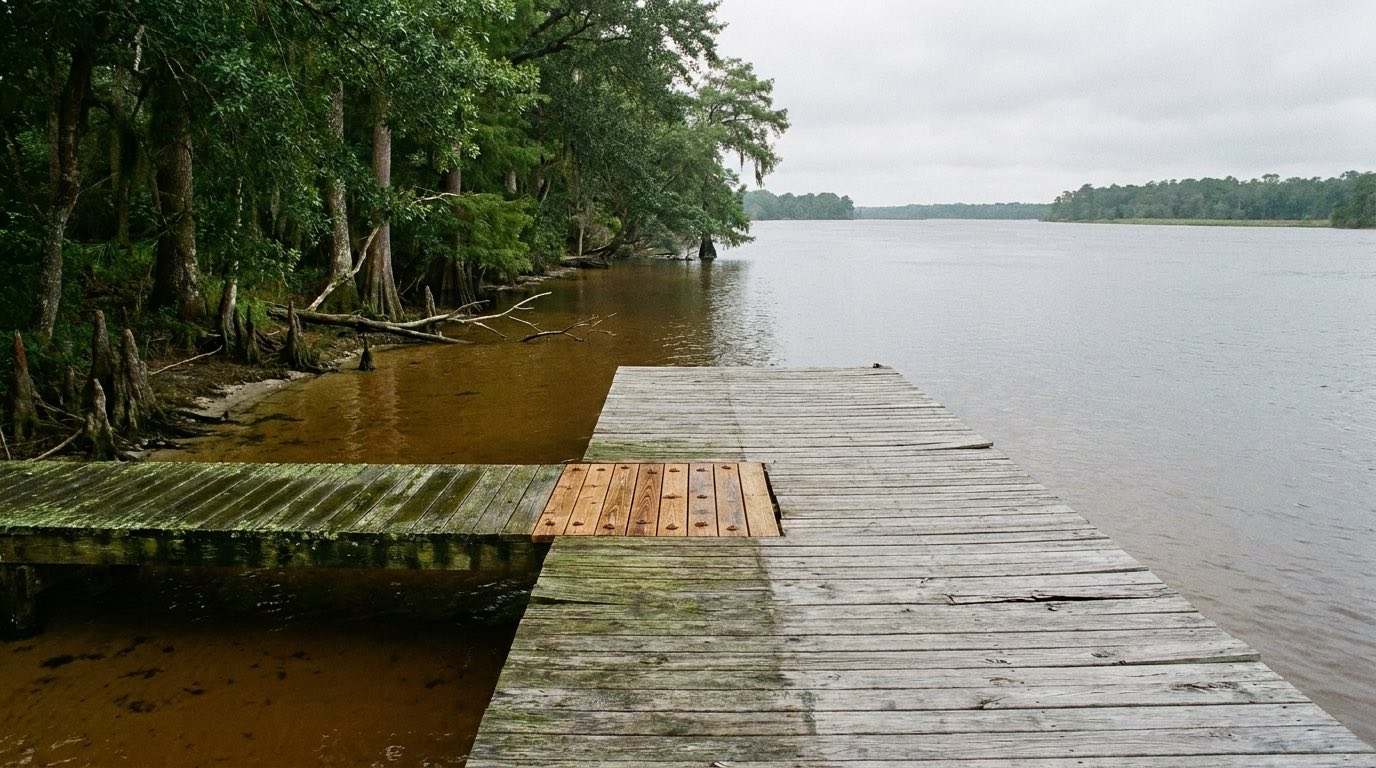
Green Cove Springs sits well up the St. Johns, on a wide, slow bend where the river has already shed most of its ocean salt. This is near-fresh, tannic water — stained tea-brown by the cypress and leaf litter feeding the river from upstream — and that changes what a dock here actually has to survive.
The thing that surprises people who moved up from the coast is how much faster things grow on a dock in near-fresh water. Salt is a growth inhibitor. Down at Mayport, hard Atlantic salt exposure keeps a lot of biological growth in check even as it eats hardware. Up here you lose that brake entirely, and any board that stays damp grows algae essentially year-round, with no winter slowdown. Combine that with the tannin staining that creeps into bare wood and the UV bleaching on the exposed stretches, and a typical Green Cove Springs dock ends up looking like two different docks: a green, slick, shaded half and a dry, gray, sun-bleached half.
Two problems on one dock, treated differently
That split is the thing to get right here. The shaded boards — under the tree line, on the north side of a boathouse, or down low near the water — are a biological problem. They're carrying green algae and black mildew rooted into the grain, and they're the genuine safety issue on the dock, because wet algae on wood is exactly how people go in the river. Those boards need cleaner chemistry that kills the growth down in the wood, not just a rinse that takes the top layer off and leaves the roots.
The sun-exposed boards are a weathering problem. They've gone flat gray because UV has broken down the surface lignin and any old sealer has long since given up. They're not slick, they're thirsty — and they'll drink tannin-stained river water straight into the grain every time it rains or the level comes up.
Our default across both is a low-pressure soft wash: dock-safe cleaners do the lifting and killing, then a gentle rinse carries it away. High pressure is the wrong tool on either half — it furs up weathered gray boards even worse than sound ones, and on the green side it just blasts the surface film off while leaving the growth in the grain to come back in weeks. Concrete, composite, and aluminum get an approach matched to what they can take.
Boat on the hard at Reynolds Park? That's the ideal time to do the dock. With the boat out of the water and the lift empty, we can work the whole structure without maneuvering around it — and both are ready when you splash.
Sealing a dock that gets no help from salt
Sealing does more work up here than most people expect. Bare wood on the upper St. Johns is absorbing tannin-stained water constantly, and there's no salinity doing anything to slow the algae down. A penetrating marine-grade sealer, put down once the boards are clean and properly dry, soaks into the grain and slows both problems at once: less moisture absorption means less cupping, less rot around the fasteners, and far less tannin staining, while a sealed surface is simply harder for algae to get a foothold on than raw, open grain.
Most Green Cove Springs docks want a wash once a year, and the heavily shaded ones often want it twice. Sealer typically runs every two to three years, though the fully sun-exposed stretches burn through it faster than the shaded ones. We'll tell you which half of your dock is driving the schedule after we've walked it.
Where we clean docks in Green Cove Springs
Most of our work here is private residential docks along the river frontage and up Governors Creek. We also clean slips, catwalks, and finger piers for owners responsible for their own space at Reynolds Park Yacht Center, and we cover the private docks running north toward Hibernia and south past town. Because Green Cove Springs is a long-term storage town, we frequently pair dock work with a detail on a boat that's been sitting — see oxidation removal in Green Cove Springs for the boat side of that.