Why Florida docks need checking twice a year
A dock in Northeast Florida ages faster than almost anywhere else in the country, and the reasons stack on top of each other. Timber sits in constant moisture. UV is unfiltered for most of the year. Biological growth never really takes a season off, so there's no winter pause the way there is further north. On salt water you add marine borers and salt-driven corrosion of every piece of hardware; on the near-fresh upper river and creeks you trade those for relentless algae and tannin-driven staining and rot.
Two inspections a year keeps up with that. Do one in late spring, before the season gets busy and while there's still time to book work. Do the second in the fall, after hurricane season — plus a quick walk-through after any named storm or unusually high water event, because that's when things move.
1. Pilings — the thing that actually holds it up
Start here, because piling failure is what turns a maintenance item into a rebuild. The most useful test is the simplest: push on it. Lean into each piling at chest height and see whether it moves independently of the structure. A piling that shifts, or a section of dock that sways more than you remember, is telling you something.
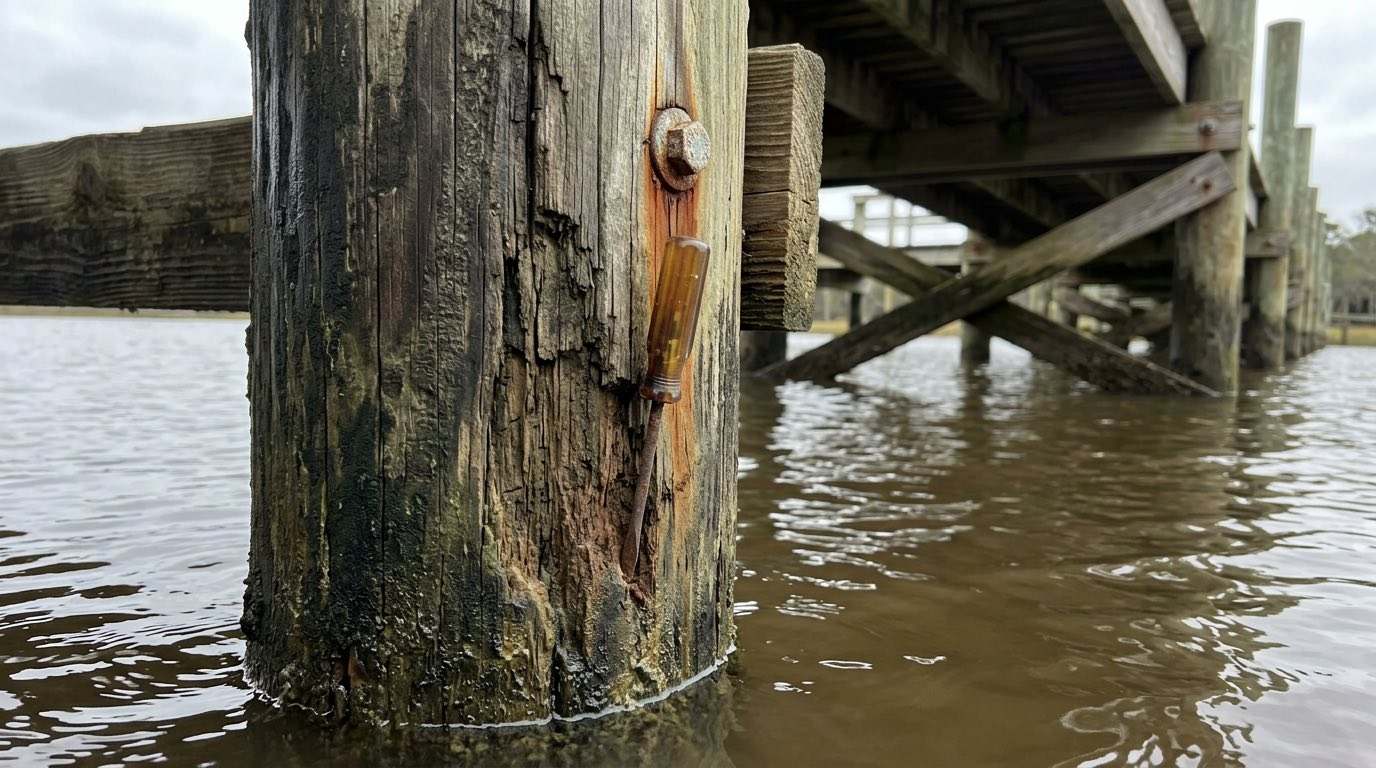
Then look at the waterline and just below it, which is where the damage concentrates. On salt water, marine borers attack below the surface and hollow a piling from the inside, producing the classic hourglassing — a visibly narrowed profile at or under the waterline while the top still looks fine. On fresh and brackish water, rot does the same job more slowly. Carry a screwdriver and probe suspect areas: sound timber resists, compromised timber takes the tip with almost no pressure. Deep checking and splitting, rust streaking bleeding down from through-bolts, and any piling that has clearly settled or leaned all belong on the list.
2. Framing, stringers, and joist hangers
Get low and look underneath, or at least at the outer edge where you can see the framing. You're looking for rot where members meet — the joints hold moisture and go first — plus rusted or missing joist hangers, corroded through-bolts, and any stringer that has visibly sagged between pilings. On docks that have gone out of level, the framing is where you'll see it: a run of decking that dips or crowns is nearly always a framing or piling problem, not a decking problem, and re-laying boards over it fixes nothing.
3. Decking — the part you see, and the part that hurts
Decking is the least structural item on this list and the most likely to injure somebody. Check for soft or spongy boards, especially near the fasteners and at board ends where water sits. Check for lifted or protruding fastener heads — a proud screw head is a bare-foot hazard and a sign the wood around it has softened. Check for splintering, cupping, and any board that flexes noticeably underfoot.
Then check the thing most people skip: traction. Green algae film on wet wood is genuinely how dock injuries happen, and it concentrates exactly where you'd expect — the shaded sections, the splash zone, the ramp to a floating dock, and the boards around the ladder. If a section is slick when wet, that's a finding, not a cosmetic complaint.
Inspect right after a cleaning. Algae, mildew, and gray weathering hide hairline cracks, soft spots, rot around bolt holes, and rust bleeding from fasteners. A freshly washed dock is dramatically easier to read — which is why the best time for your inspection walk is right after a dock cleaning.
4. Fasteners, hardware, rails, and ladder
Salt water eats hardware, and Northeast Florida's coastal docks show it. Work along the dock checking cleats for tightness, rails for movement, and the ladder for corroded mounting hardware and loose rungs — the ladder is the single most common failure point people actually get hurt on. Look for rust streaks running down from bolt heads, which tell you corrosion is happening inside the joint where you can't see it, and for any galvanized fitting that has gone past surface rust into flaking and section loss. Note whether dissimilar metals have been mixed anywhere, because that accelerates the whole process.
5. Boat lift and electrical
Give the lift a visual pass: frayed or rust-stained cables, worn or seized pulleys, bent or corroded cradle beams, bunks that have gone soft, and the general condition of the motor housing and its mounting. Cycle it and listen — a lift that has started groaning, hesitating, or running unevenly is telling you something is wearing.
Check any dock electrical carefully but do not open anything: corroded or cracked outlet covers, non-GFCI receptacles, and damaged conduit are all findings, and all of them are for a licensed electrician. Water and dock wiring is not a category for do-it-yourself investigation.
Where the line falls: maintenance vs. licensed work
This is the part worth being precise about. Cleaning, sealing, and swapping the occasional individual deck board are normal owner maintenance. You can do them, or hire them out to a cleaning outfit, without any of it being a licensed trade.
Structural marine work is a different category. In Florida, work on pilings, framing, bulkheads, seawalls, and boat lifts is licensed marine contracting, and it generally requires permitting through your county — often with the Army Corps of Engineers or the water management district involved as well. If your inspection turns up a moving piling, sagging framing, a dock that has gone out of level, or a lift with mechanical problems, the correct next call is a licensed marine contractor, not a handyman and not a pressure washing company.
That's our own line too. We clean and seal docks across Jacksonville and the 904 — that's the surface. We don't do structural repair, and when we're out washing a dock and something looks wrong in the structure, we tell you plainly so you can get the right trade out to look at it.