
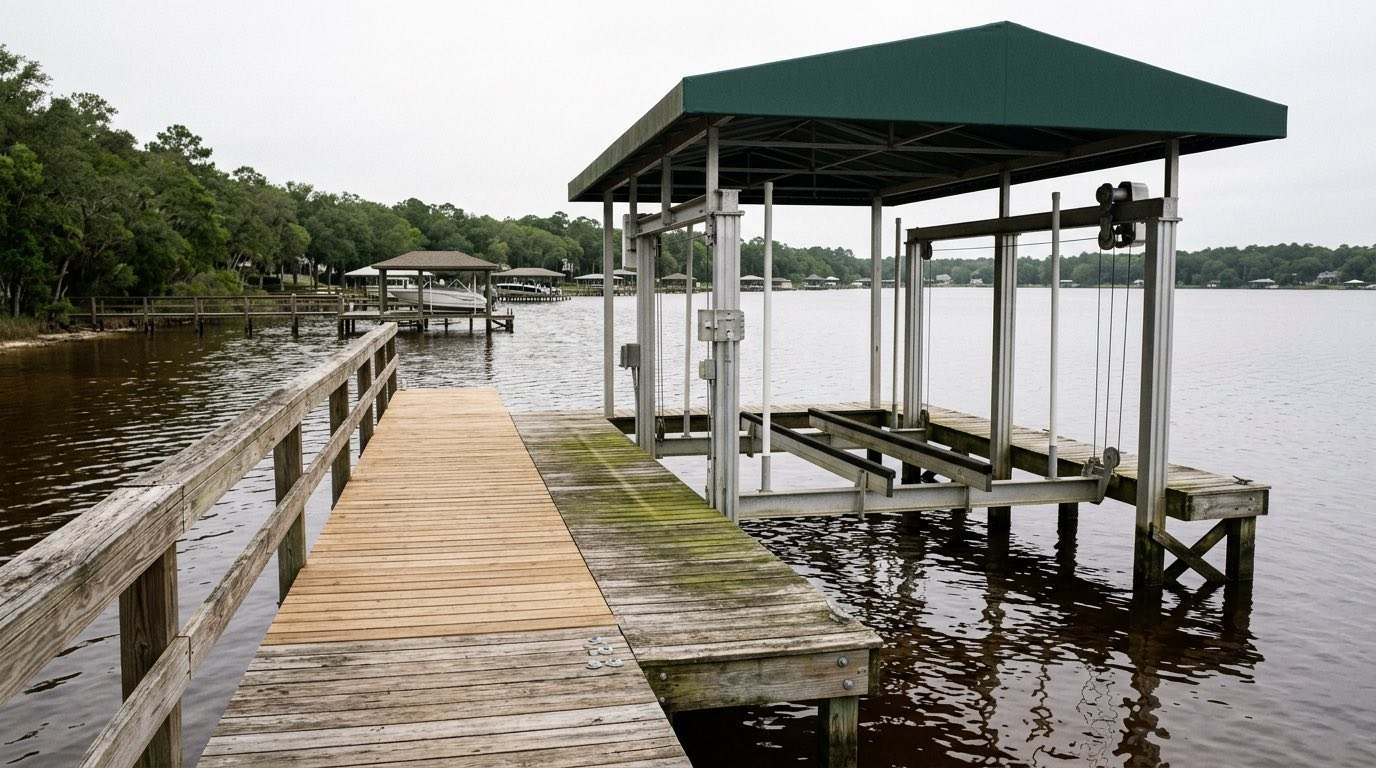
The most heavily docked water in Northeast Florida
Doctors Lake opens wide off the St. Johns, and the shoreline that rings it is lined with more private docks and boat lifts than almost anywhere in the region. From the neighborhoods around Pace Island to the coves that finger off the main body, nearly every backyard on this lake ends in a dock, a lift, and a family boat. That density is why we run Fleming Island as a regular route — and it's why dock cleaning here is rarely a one-off. When your neighbor's boards come back honey-colored and yours are still green, you notice.
What makes these docks different from the ones down at the river mouth is the water itself. Doctors Lake is near-fresh and tannic — dark, tea-colored water stained by cypress and leaf litter draining in from upstream. There's no meaningful salt here and no barnacle set. What you get instead is soft growth: a persistent green algae film on anything that stays damp, black mildew working into the grain, and a brown tannin tint that soaks into bare wood every time the water comes up or a wake washes across the low boards.
Tannin staining is a chemistry problem, not a pressure problem
This is the part most homeowners get wrong on Doctors Lake. When a dock here looks dirty, a lot of it isn't dirt sitting on top of the wood — it's tannin that has soaked into the wood, plus algae rooted down in the grain. Hitting that with a high-pressure wand feels productive because you can see a clean stripe appear, but what you've actually done is erode the soft summerwood, raise the grain, and leave wand lines. The brown comes back, because you never removed it; you just took off the surface it was sitting on.
Our approach on Doctors Lake wood is a low-pressure soft wash with cleaners chosen for tannin and organic growth. The chemistry lifts the staining and kills the algae down in the grain, then a gentle rinse carries it off. The boards come out evenly toned instead of striped, and the surface is left intact enough to actually take a sealer afterward. Composite decking, concrete, and aluminum gangways get an approach matched to what they can safely handle.
Got a lift? We clean the decking, catwalks, and visible lift structure as part of the job. Motors, cables, and mechanical repair are licensed marine contractor work — we don't do those, but we'll flag anything that looks like it needs attention while we're out there.
Sealing against water that never stops rising
Sealing matters more on Doctors Lake than on a lot of the water we work. Because the lake is near-fresh and the low docks here sit close to the surface, boards get wetted constantly — by rain, by wake, and by the seasonal swings that put the lower deck level under water outright. Bare, unsealed wood in that environment absorbs, swells, cups, and eventually starts to rot from the fastener holes outward.
Once the boards are clean and properly dry, we put down a penetrating marine-grade sealer that soaks into the grain rather than sitting on top as a film. It slows the absorption that drives cupping and rot, and it dramatically slows how fast the tannin staining returns — sealed wood doesn't drink the tea-colored water the way bare wood does. On most Fleming Island docks that means a wash every year and sealer every two to three, though heavily shaded low docks often want the wash twice a year.
Where we clean docks on Fleming Island
Almost all of our Fleming Island work is private residential docks and boat lifts on Doctors Lake — the standard setup here of a walkway out, a covered lift, and a deck platform. We also clean catwalks and finger piers for owners with slips at Doctors Lake Marina, the docks around the Whitey's Fish Camp stretch of water, and the St. Johns River-side docks along the eastern edge of Fleming Island. If your dock is on Doctors Lake or the river frontage nearby, we cover it.