The docks most Jacksonville crews never reach
Amelia Island sits at the very top of Northeast Florida, and that distance is the whole story. Fernandina Beach is the far edge of the map for most Jacksonville detailers and pressure washing outfits, so the docks up here get overlooked — nobody wants to make the drive. We do, on a regular route, and that covers the whole island: the historic downtown waterfront around Fernandina Harbor Marina at the foot of Centre Street, the protected creek at the Amelia Island Yacht Basin, and the quieter marsh-side docks running south through Amelia City and American Beach.
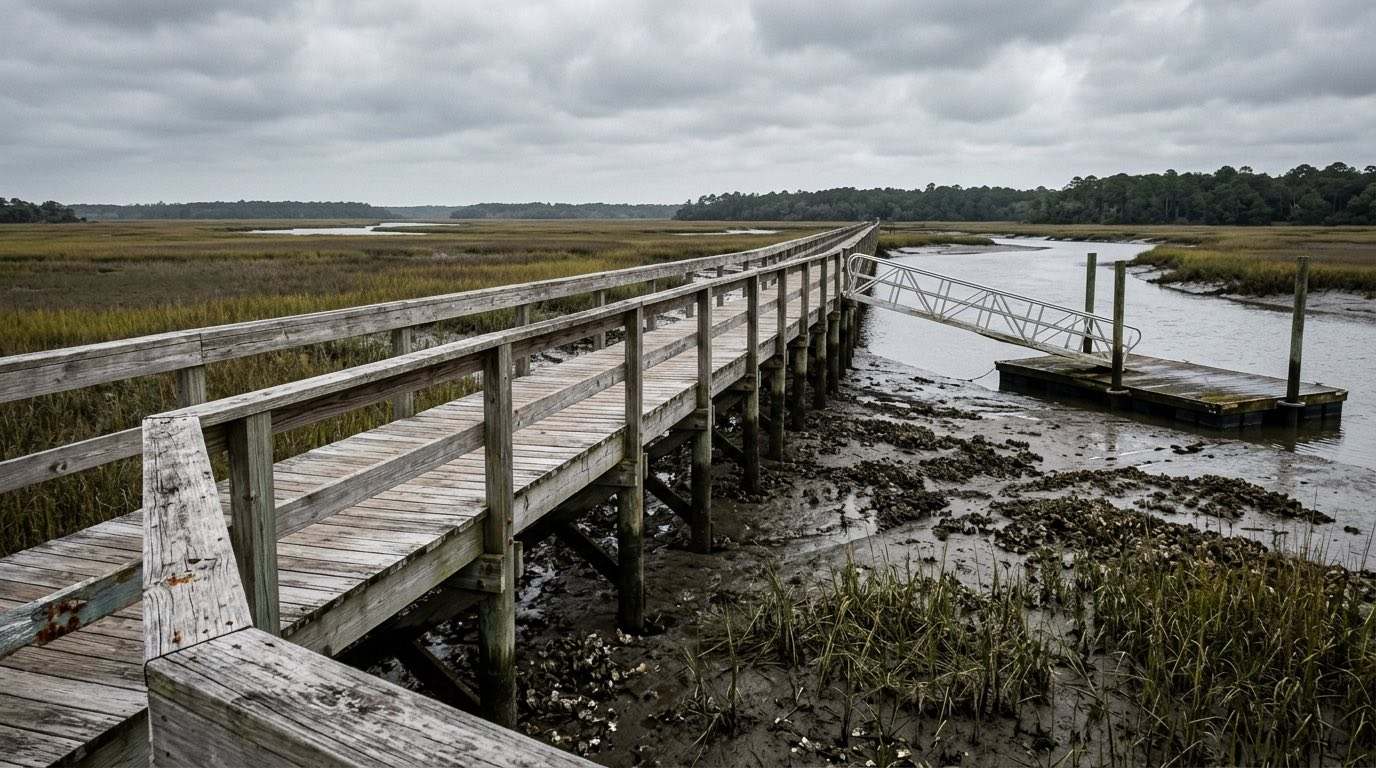
What makes an Amelia dock its own kind of job is the salt marsh. Most private docks here aren't a short step off a bulkhead into deep water — they're long timber walkways striking out across the spartina grass, sometimes several hundred feet, to reach a ramp, a floating dock, or a lift in the creek channel. That structure crosses tidal marsh the entire way, which changes what it's exposed to and where it fails.
Big tides, and everything they do to a dock
Amelia sees one of the larger tidal swings in Northeast Florida, and on a marsh dock the tide is the dominant force. Twice a day the lower boards, the ramp, the float, and the piling splash zone go from submerged in salt water to drying in the sun. That constant cycling is what drives the wear here, and it's why an Amelia dock is usually in dramatically different condition at the top than at the bottom.
The walkway decking up on the marsh is a sun-and-salt problem: full exposure, no canopy, salt spray drying into the grain, boards bleaching flat gray and opening up. The ramp, float, and lower structure are the opposite — shaded underneath, wet most of the time, and carrying black mildew, marsh mud staining, and the slick biological film that makes a wet aluminum-and-timber ramp one of the genuinely dangerous surfaces on a property. A dock that looks fine from the house can have a ramp you shouldn't be walking down with your hands full.
We plan Amelia visits around the tide. The ramp, float, and piling splash zone are only properly workable at certain stages — so we schedule for it rather than cleaning the easy top run and leaving the part that actually matters.
Soft washing marsh docks
Long marsh walkways are usually older, and they take a hard life. Sun-and-salt-weathered boards have an already-open grain, and high pressure tears them up — furring the surface, stripping soft fiber, and leaving wand tracks in wood that had years left in it. On the wet lower structure, high pressure blasts the surface film off the mildew while leaving the growth rooted in the grain, so it's back within weeks.
Our default across the whole structure is a low-pressure soft wash: dock-safe cleaners flush salt from the grain, lift the marsh-mud and tannin staining, and kill the mildew down where it lives, and a gentle rinse carries it away. Thorough fresh-water rinsing matters a lot on salt water. The aluminum ramps and float framing common up here, plus composite decking and concrete, each get an approach matched to what they can safely take. Rails, ladders, cleats, and dock boxes are cleaned along the way.
Sealing on the island
Sealing does double duty on Amelia. Once the boards are clean, salt-flushed, and properly dry, a penetrating marine-grade sealer soaks into the grain and slows the two things chewing on a marsh dock at once — the salt-and-moisture cycling that opens up the wood and rots it around the fasteners, and the UV that bleaches the exposed walkway gray.
The honest caveat is that Amelia's exposure burns through sealer faster than the sheltered river docks upstate. Where a shaded dock on the St. Johns might comfortably go three years, an exposed marsh walkway here often wants resealing closer to every two. Most island docks want a wash annually — and the ramp and float sections, being the safety-critical part, are worth doing on a shorter cycle than the walkway if you're spacing the work out.
Where we clean docks on Amelia Island
Our Nassau County dock work covers private marsh and creek docks along the Amelia River and its tributaries, the walkways, ramps, floats, and lifts that go with them, and slips, catwalks, and finger piers for owners responsible for their own space at Fernandina Harbor Marina and the Amelia Island Yacht Basin. We work Fernandina Beach, Amelia City, American Beach, and the docks down the island toward the south end. See all our Amelia Island services for the boat side.