
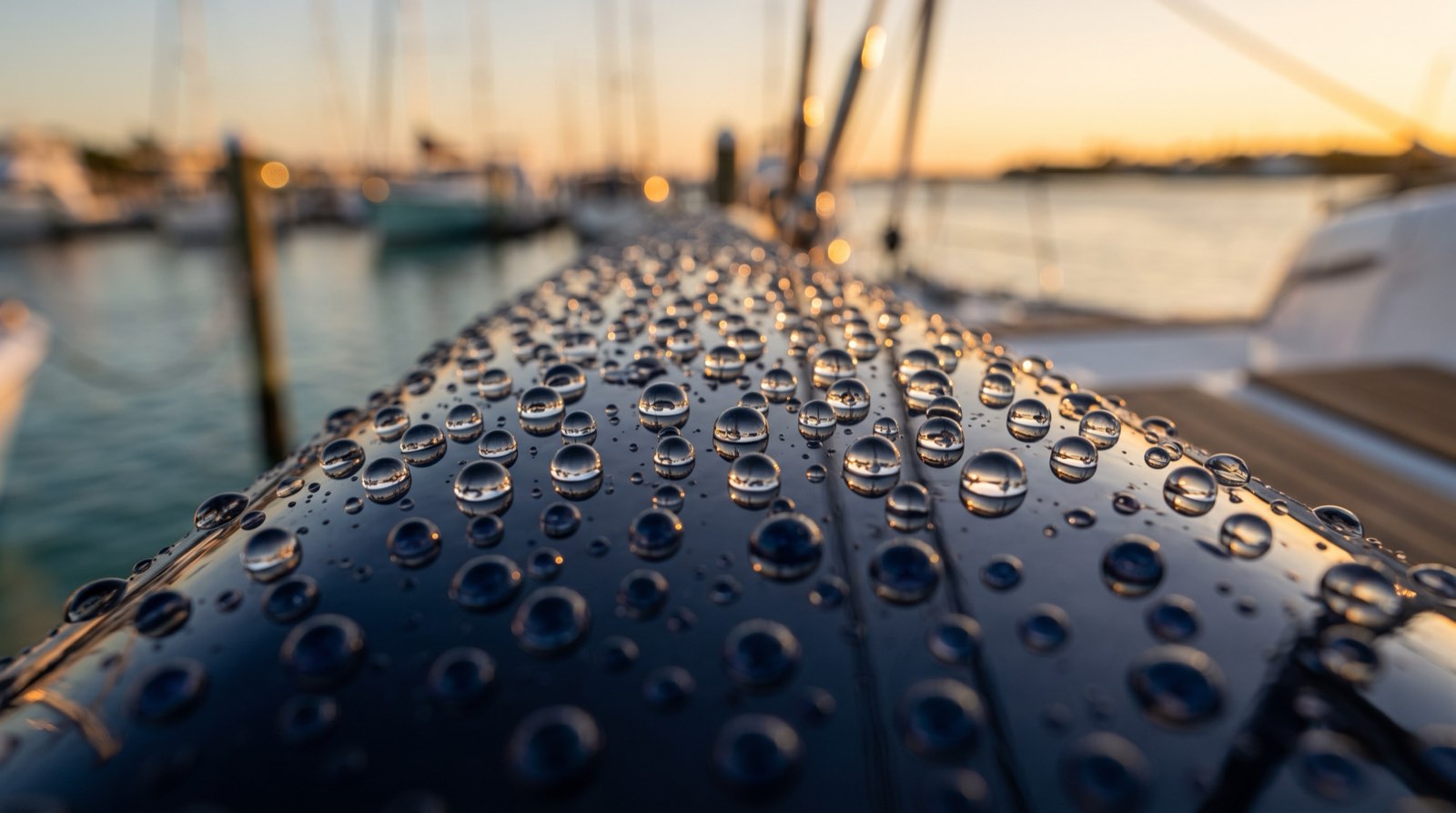
What a ceramic coating actually is
A marine ceramic coating is a liquid polymer — usually SiO₂-based — that chemically bonds to the gelcoat and cures into a hard, glass-like layer. Unlike wax, which sits on the surface and washes away over weeks, a cured ceramic becomes the surface. That's why it lasts years instead of months, and why it can't just be wiped on: the gelcoat has to be corrected and clinically clean before application, because you're sealing in whatever's underneath.
What it does brilliantly: sheds salt and grime so washes take half the time, blocks the UV that oxidizes gelcoat, resists waterline scum, and holds a deep gloss that wax can't match past week three. What it does not do: make the boat wash itself, stop barnacles below the waterline, or survive being cleaned with abrasive pads. Coated boats still need regular washing — they just need much less of it, and it works.
The wax-vs-ceramic math
Run the numbers on a 25 ft boat kept on the water in Jacksonville over three years:
- The wax route. Florida sun and salt kill a coat of wax in 2–3 months, so staying protected means 4+ wax applications a year. Done professionally that's roughly $500 a visit ($17–$25/ft with the wash) — call it $2,000 a year, $6,000 over three. Done yourself it's cheaper in dollars and expensive in weekends, and most owners quietly fall behind, which is how hulls end up chalky.
- The ceramic route. A professional marine ceramic coating runs $60–$150 per foot — say $1,500–$3,750 for that 25-footer, including the paint correction beforehand. Then maintenance is just washes for the next several years, each one faster and cheaper because nothing sticks to the hull.
The coating roughly pays for itself between year one and year two for an on-the-water boat — and that's before counting the resale value of a hull that never got the chance to oxidize. (All the per-foot numbers behind this math are broken down in our Jacksonville detailing price guide.)
When ceramic is clearly worth it
- Boats kept in a wet slip or dry stack — constant sun and salt exposure is exactly what ceramic exists for.
- Dark hulls. Navy, black, and red gelcoat show oxidation fastest and fade hardest. Ceramic's UV barrier earns its keep most on dark colors.
- Offshore fishing boats. Salt spray on every surface, every trip. A coated center console rinses clean at the dock in minutes — which is why coatings pay off fastest on offshore boats at Jacksonville Beach and along the ICW in Ponte Vedra.
- Owners who hate maintenance. If honest self-assessment says the boat won't get waxed four times a year, ceramic is the difference between a protected hull and a slow slide to chalk.
When we'd tell you to skip it
Ceramic isn't the answer to everything, and anyone quoting it as one is selling. Skip it when: the boat is garage- or cover-kept and lightly used (twice-yearly sealant genuinely covers that case for a fraction of the price); the hull is heavily oxidized and you're not ready to pay for correction (coating over chalk seals in chalk — the correction is most of the job and most of the cost); or the boat is a short-term keeper being sold this season, where a full detail gets you the sale-day gloss without the multi-year investment.
One more honesty check: the coating is only as good as the prep. A $500 “ceramic special” that skips correction is a wax-priced product with a ceramic label. If the quote doesn't include machine correction before coating, keep shopping.