Why a ceramic coating is the smartest money you'll spend on a Florida boat
Northeast Florida is one of the harshest environments in the country for gelcoat. Between the salt of the Atlantic and the Intracoastal, the brackish push of the St. Johns, and a subtropical sun that runs nearly year-round, an unprotected hull starts oxidizing within a season or two. A marine ceramic coating is the single most effective way to stop that clock. Instead of sitting on the surface like wax, the coating chemically bonds to the gelcoat and forms a hard, glass-like layer that stays put for years. (Skeptical? Good — read our unsalesy take on whether ceramic is actually worth it, including when it isn't.)
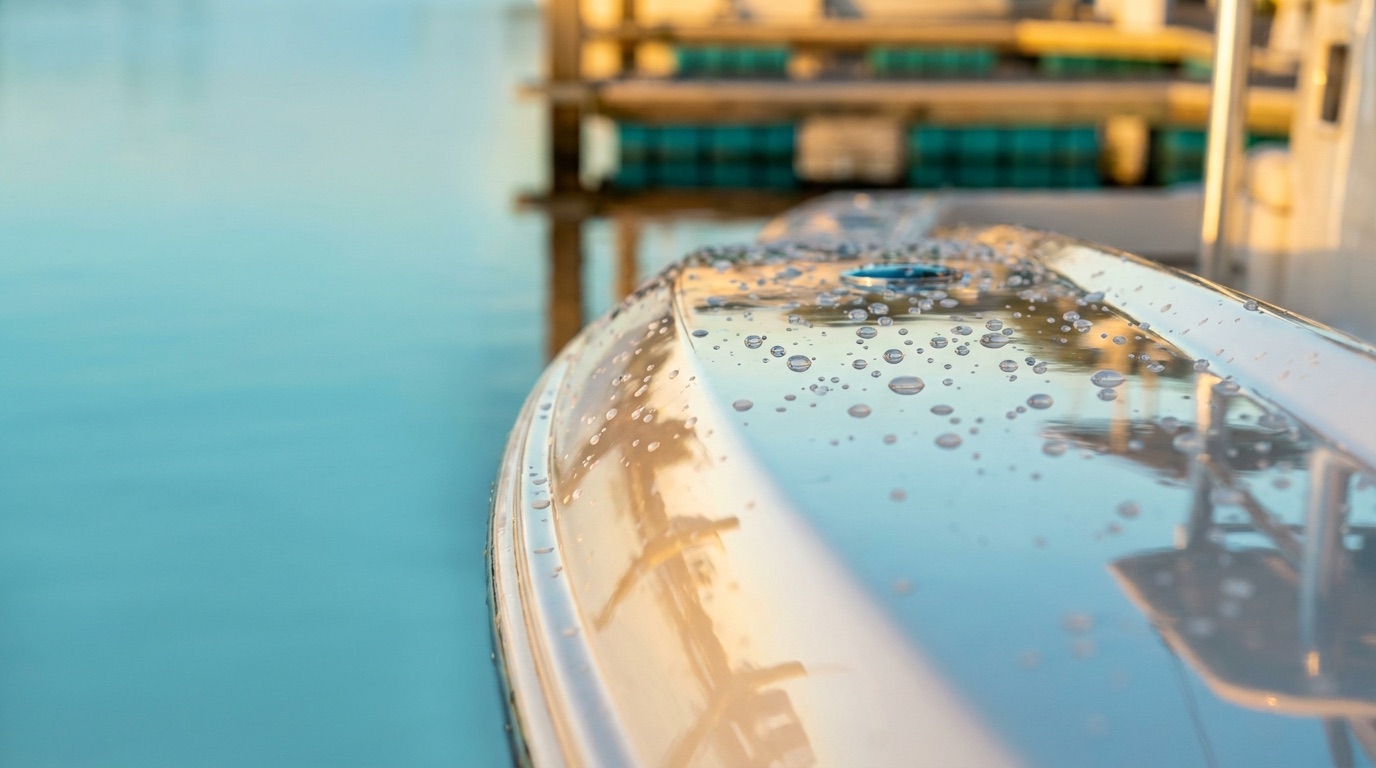
That layer does three things Florida boat owners care about: it blocks the UV that chalks and fades your gelcoat, it makes the surface so slick that salt, algae, and water spots struggle to grab hold, and it turns your weekly wash-down into a five-minute rinse instead of an hour of scrubbing. On a boat that lives on the water, that difference compounds fast.
What ceramic coating actually protects against here
- UV oxidation. The number-one killer of Florida gelcoat. The coating's UV inhibitors keep the finish from going chalky and white.
- Salt and mineral staining. A slick, non-porous surface means salt rinses away instead of etching in and pitting metal or staining fiberglass.
- Fouling and waterline scum. Above the waterline, growth and grime release far more easily, so your maintenance stays quick.
- Fuel and dock stains. Spills and rub marks wipe off the coated surface rather than soaking into the gelcoat.
Correction first — the part that actually makes it shine
Here's the thing most people don't realize: a ceramic coating is transparent and permanent-ish, so it locks in whatever is underneath it. If your hull has swirl marks, oxidation, or water spots, the coating seals those in. That's why the real work — and most of the labor — is the paint correction that happens before a single drop of coating goes on.
On a typical Jacksonville job we wash and decontaminate the hull, clay-bar out embedded contaminants, then compound and polish the gelcoat back to a deep, defect-free gloss. Heavily oxidized hulls may need multiple stages. Only once the surface is corrected, cleaned, and wiped down with a prep solvent do we lay the coating and let it cure. Skip the correction and you've paid premium money to preserve a dull finish — we don't do that.
Ceramic vs. wax, plainly: a good marine wax lasts two to four months in Florida sun and needs constant reapplication. A professional ceramic coating lasts two to five years, protects far better, and costs less over its life once you count all the waxing you didn't have to do.
What it costs to ceramic coat a boat
Marine ceramic coating runs $60–$150 per foot in Jacksonville, and on a typical 20–30 ft boat the job lands between $2,600 and $4,400 with the correction included. Those two numbers describe the same job from different angles, and it's worth understanding why the real-world figure sits toward the upper half of the per-foot band.
The coating itself is a small share of the cost. What you're paying for is the correction work underneath it — the wash, decontamination, machine compounding, and polishing that has to happen before anything gets sealed. A coating is permanent-ish and completely honest: it locks in whatever surface it goes over. Skip the correction and you've paid to preserve the swirls and chalking for the next three years. That's why the hours in front of the coating, not the bottle, set the price.
So the spread inside $60–$150/ft is almost entirely how much correction your gelcoat needs:
- Toward $60–$90/ft — a newer or well-maintained boat with sound gelcoat. Light polish, then coat. Not much to undo.
- Toward $90–$120/ft — the common case. Some dullness, light-to-moderate oxidation, a stained waterline. A full compound-and-polish stage before coating.
- Toward $120–$150/ft — heavy chalking, deep swirls, or neglected gelcoat needing wet-sanding and multiple compounding passes. This is oxidation removal depth of work, done as the foundation for the coating.
There's also a practical floor. A small boat still needs the same setup, decontamination, correction stages, controlled application, and cure time as a bigger one, so per-foot math alone understates a short hull — which is why a 20-footer doesn't come in at the bottom of the range in practice.
Two things that genuinely lower the number: coat it before it needs correcting (the single biggest lever — a boat coated while the gelcoat is still healthy skips the most expensive stage entirely), and bundle it with work already scheduled, since we're on site with the boat prepped either way. For how the cost compares against years of waxing, our guide on whether ceramic coating is worth it runs the three-year math both directions, including the cases where we'd tell you to skip it. Full rates for every service are on the pricing page.
How long it lasts and how to keep it
Depending on the product and how your boat is stored, a coating we apply generally holds up for two to five years. Boats kept on a lift or trailer and rinsed regularly get the longest life; boats that live in a wet slip year-round see the shorter end. Either way, upkeep is simple: rinse after use, wash with a pH-neutral marine soap, and let us do a maintenance detail a couple of times a year. Many owners pair the coating with our wash & wax maintenance plan so the protection is topped up and inspected on a schedule.
What kinds of boats we coat
Center consoles, bay boats, offshore fishing boats, cruisers, pontoons, and personal watercraft all benefit. Bigger boats cost more in absolute dollars but often less per foot; badly oxidized boats cost more because the correction takes longer. We quote every boat by the foot after seeing its condition, so you know the number before we start. If your gelcoat is already chalky, start with our oxidation removal service — it's the same correction step, and it can roll straight into a coating.