Why a center console needs its own kind of detail
A center console is built to be run hard offshore, and that means it gets punished in ways a garaged runabout never does. Every trip out of Mayport, the St. Johns inlet, or the Jax Beach and Ponte Vedra ramps coats the boat in heavy Atlantic salt, and that salt doesn't just sit there — it cakes on rails, hardware, and rod holders, dulls the gelcoat, and works into every seam. Add relentless Florida sun on wide-open, unshaded decks and you get gelcoat that oxidizes and chalks faster than almost any other hull in the area.
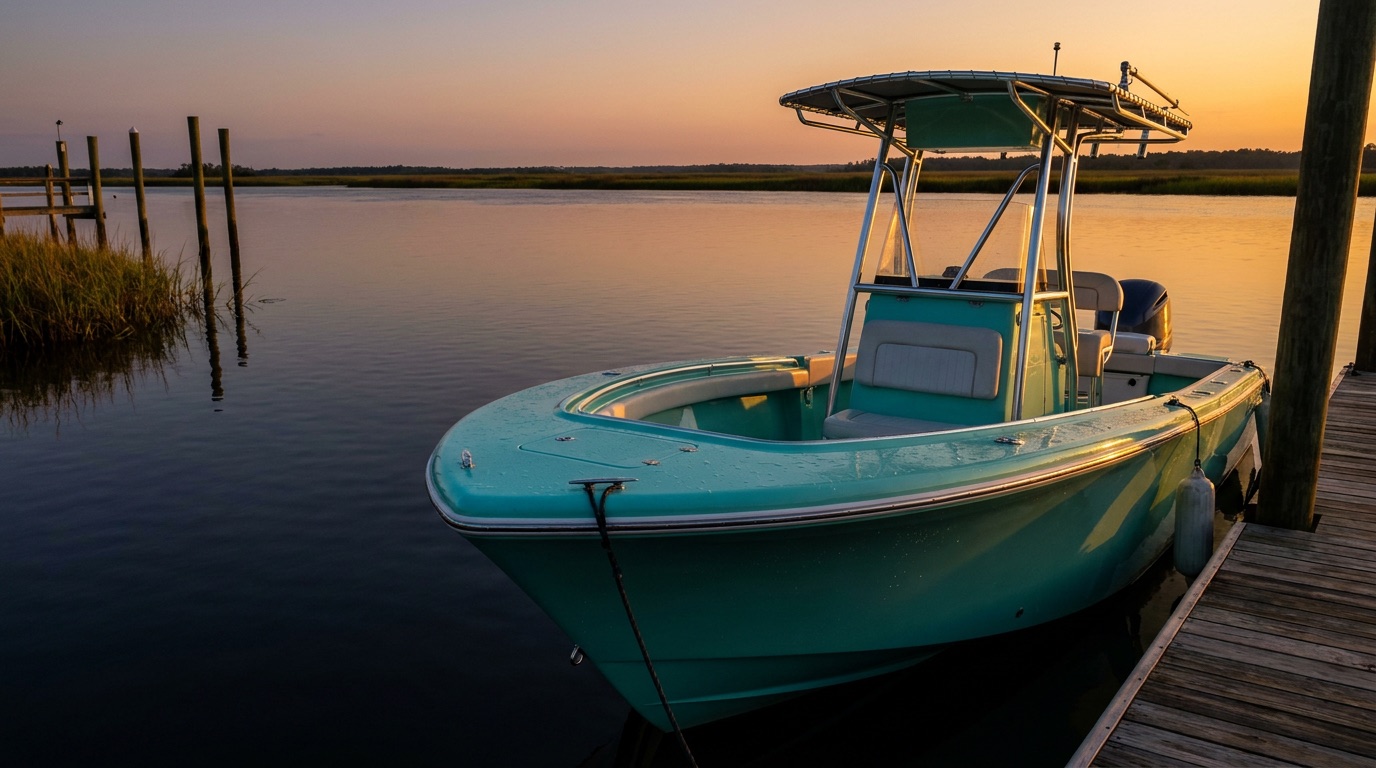
Detailing a center console properly starts with a thorough salt flush and hand wash to strip that offshore build-up before anything else, because polishing salt into the gelcoat only scratches it. From there we work the surfaces that make a fishing boat a fishing boat: the wide non-skid decks you stand and fight fish on, the T-top or hardtop overhead, the console and its electronics area, the leaning post and tackle stations, and the gunwales and rod holders where salt and bait residue collect. It's a different job than a cabin cruiser, and we treat it like one.
The non-skid decks get a deep clean first. That textured, molded-in pattern is what keeps you on your feet in a chop, but it's also a trap for sand, dried fish blood, chum, and salt. We scrub it with the right brushes and marine deck cleaners that pull grime up out of the grooves without grinding the texture flat, then rinse it clean so nothing is left behind to turn slick underfoot. A center console with genuinely clean non-skid is safer as well as better looking.
Overhead, the T-top and hardtop get washed, the powder-coated or aluminum frame wiped down where salt corrodes fastest, and the canvas or fiberglass top cleaned so it isn't dripping grime onto the deck below. The console and helm area — screens, electronics housing, wheel, switches, and the whole dash — is detailed carefully around the sensitive gear, and cup holders and cubbies are cleaned out. The leaning post, seating, and tackle storage are cleaned and, where there's vinyl, conditioned and UV-protected so the Florida sun doesn't crack it.
Offshore salt, sun, and protecting your gelcoat
The two things that age a Jacksonville center console are salt and sun, and both hit this style of boat harder than most. The heavy salt load from offshore Atlantic runs is corrosive — it pits hardware, hazes stainless, and, left on the gelcoat, accelerates oxidation. That's why we pay close attention to the gunwales, rails, rod holders, and cleats, flushing and cleaning the metal and the surrounding gelcoat rather than just hitting the flat surfaces. Salt that stays in the rod holders and hardware is what turns into corrosion and staining down the line. (The habit side of that fight is in our saltwater maintenance routine.)
On the wide-open decks and hull sides, that same sun-and-salt combination is what causes the chalky, faded look so many working center consoles get. Where the gelcoat has already oxidized, a compound-and-polish step cuts back the dead, chalky layer and restores the depth and gloss underneath — see our oxidation removal service for what that involves. Bad cases on the hull sides below the rubrail may also call for attention with our hull & bottom cleaning.
Once the gelcoat is clean and corrected, the smartest move on a boat you run hard is to protect it. A marine ceramic coating makes the gelcoat shed salt and water so post-trip washdowns are faster and far more effective, and oxidation is much slower to return under the coating. On an offshore center console that lives in the sun and eats salt every weekend, that protection pays for itself in easier maintenance and a hull that keeps its shine for years.
Run offshore? Salt is the enemy — beat it with routine. A ceramic-coated gelcoat plus a regular salt-off after your Mayport and offshore trips keeps a working center console looking sharp with a fraction of the effort. Ask us to pair a full detail with ongoing protection.
At your dock, dry stack, or driveway
Most center consoles in the 904 live on a lift, in a wet slip, or in dry-stack storage between trips — so that's where we detail them. We come to your dock, marina, or the dry stack and work the boat right there, across Duval, Clay, St. Johns, and Nassau. We bring our own products, water, and power; you get back a center console with clean non-skid, fresh gelcoat, and the salt knocked off — ready for the next run offshore.