
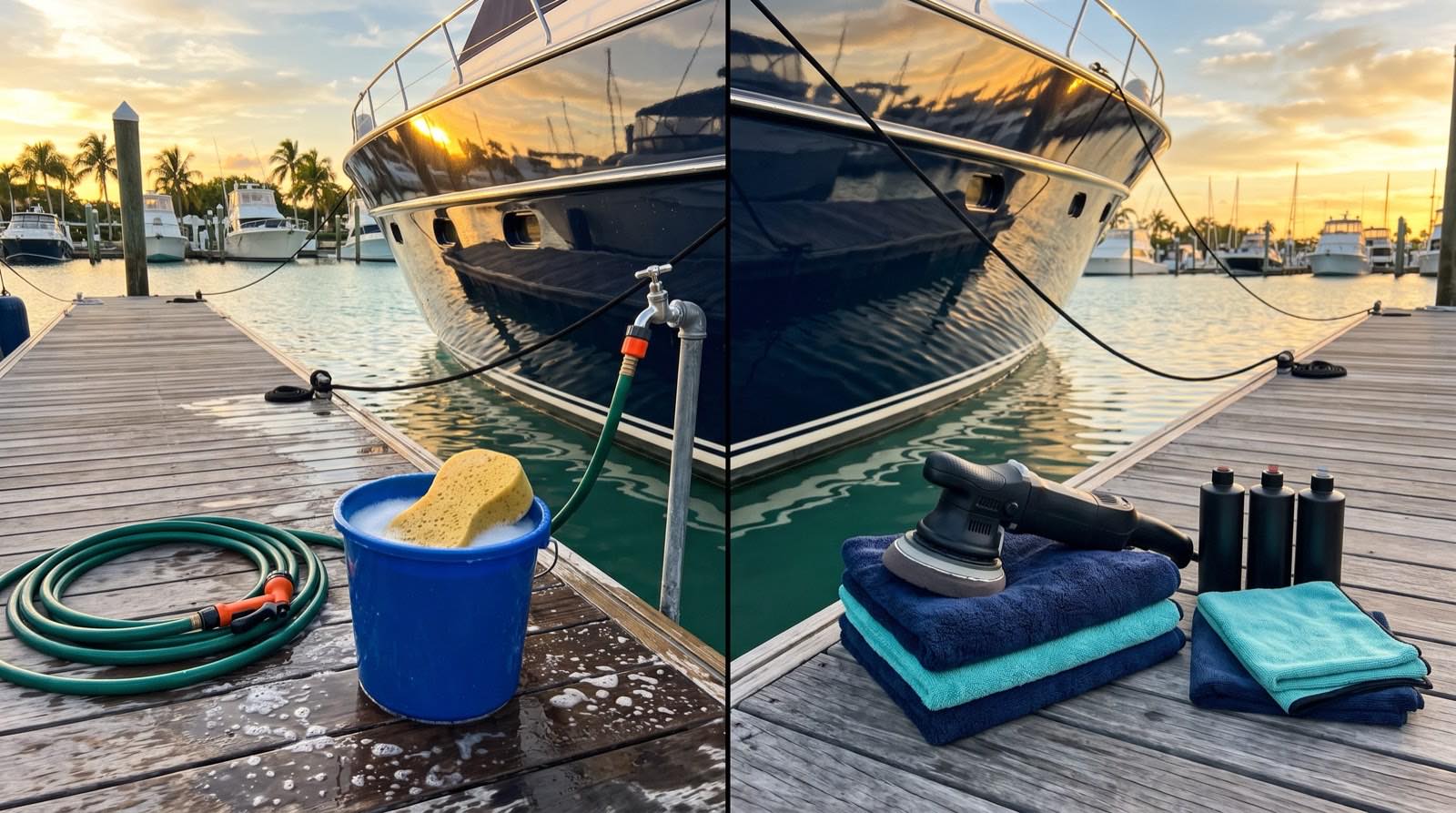
What DIY does genuinely well
Nobody needs a professional to wash a boat. With marine soap, a soft brush, and a hose you can handle the weekly wash, the post-trip salt rinse, vinyl wipe-downs, and waxing a smaller hull — and doing it yourself has real advantages beyond money. You notice the loose cleat, the spider crack, the seam starting to lift, because you're the one with hands on the boat every week. For a trailered boat under 22 ft or so, an owner with a Saturday rhythm can keep the finish at 90% of professional condition indefinitely.
The products that matter: real marine soap (not dish soap, which strips wax), a dedicated vinyl cleaner and protectant, and a quality marine wax or sealant. Maybe $150 a year in consumables.
Where DIY hits the wall
The wall is correction — any job where you're removing material instead of removing dirt. Oxidation compounding, wet-sanding, scratch removal, and ceramic coating prep all involve cutting into a gelcoat layer that doesn't grow back, with machines that reward experience and punish enthusiasm. It's not that owners can't learn — it's that the learning happens on your own hull, the tools cost $400+ before products, and the failure modes (burn-through on edges, holograms, coating over contamination) cost more to fix than the pro job did.
Size is the other wall. A 30 ft boat has roughly 400 square feet of gelcoat plus metal, glass, and vinyl. Compounding it by hand isn't a project; it's a punishment.
The time math nobody runs
Be honest about hours. A proper full detail — wash, clay, compound, polish, protect — runs a professional crew with machines most of a day. The same job DIY, first time, with a single polisher and learning curve: 20–30 hours across multiple weekends on a mid-20s boat. If your working time is worth even $30 an hour, that's $600–$900 of weekends — plus $400+ in tools — to save a $600–$945 professional detail — before buying the polisher, pads, and compounds. The math only favors DIY correction if you enjoy the work itself. (Some people genuinely do. If that's you, buy a dual-action, not a rotary, and practice on the transom first.)
For routine washes the math flips completely: 45 DIY minutes at the dock costs nothing and keeps protection alive. That's why the hybrid split wins.
The hybrid approach (what we'd actually recommend)
Owners who keep boats looking new for a decade almost all run the same play: DIY the routine, schedule the correction. You do post-trip rinses and washes (or put the boat on a maintenance plan at $17–$25/ft if the schedule keeps slipping); a pro does a full detail once or twice a year and handles anything involving a machine. See our pricing page for the per-foot numbers on every service.
If you do hire out, vet for: marine-specific experience (car detailers underestimate gelcoat), by-the-foot quotes in writing, insurance, and no pressure to buy a ceramic coating before your oxidation is corrected. A good detailer will happily tell you what not to pay them for — it's the ones who quote ceramic on a chalky hull sight-unseen you walk away from.